When pain has dragged on for weeks or months, most people are not looking for another vague recommendation to just “keep moving”. They want a clear answer about laser therapy vs physiotherapy recovery – which one helps, when it helps, and whether one is actually better for their condition.
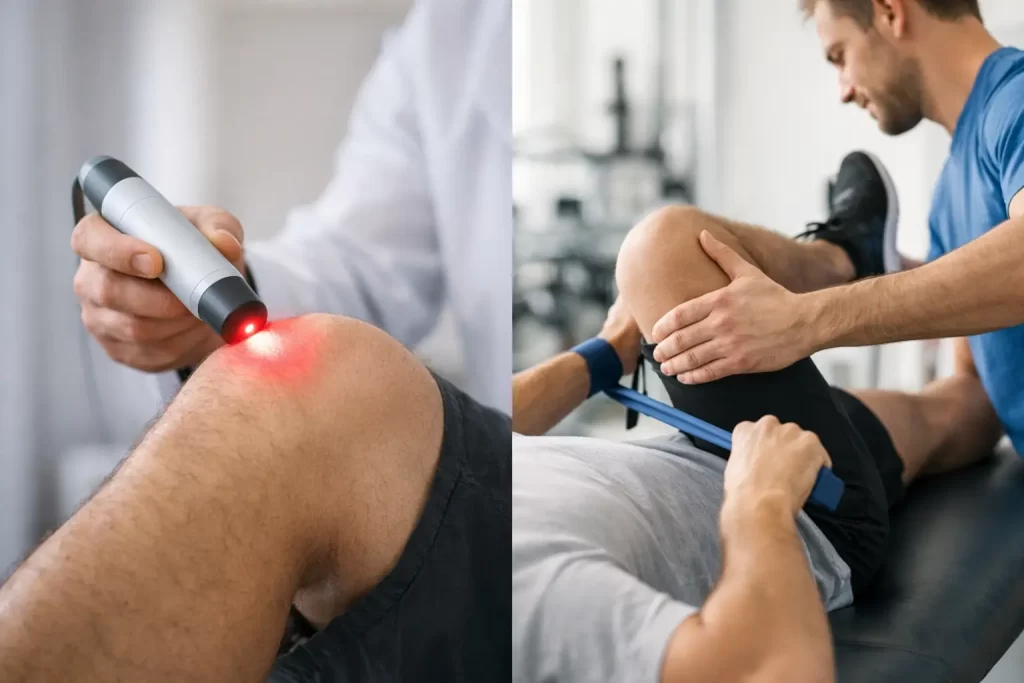
The honest answer is that they are not direct substitutes in every case. Physiotherapy and photobiomodulation therapy, also called low-level laser therapy, work in different ways. One primarily uses movement-based rehabilitation and manual strategies to improve function. The other uses specific wavelengths of light to support tissue repair, reduce inflammation and help calm pain at a cellular level. For some patients, the best option is one or the other. For many, the strongest recovery plan uses both – but in the right order and for the right reason.
What makes laser therapy vs physiotherapy recovery different?
Physiotherapy is designed to assess how your body moves, where it is compensating and what strength, flexibility or motor control deficits may be contributing to pain. Treatment can include exercise prescription, manual therapy, education, taping and return-to-activity planning. It is often highly effective when the main issue is deconditioning, stiffness, poor movement patterns or the need to rebuild function after injury.
Laser therapy targets a different part of the recovery process. Photobiomodulation therapy delivers light energy into injured or irritated tissue to stimulate cellular activity. In practical terms, that can support circulation, reduce inflammatory load, encourage tissue healing and lessen pain sensitivity. It does not rely on forceful manipulation or strenuous exercise, which makes it especially useful when pain is too acute, too persistent or too reactive for active rehabilitation to progress comfortably.
That distinction matters. If your shoulder pain is being driven by poor scapular control and weakness, exercise-based rehabilitation is essential. If your tendon, nerve or joint is so inflamed that every movement flares symptoms, laser therapy may help settle the tissue enough for rehabilitation to become possible.
When physiotherapy is likely to be the better first step
Physiotherapy is often the right starting point when recovery depends on restoring strength, control and confidence in movement. This is common after ankle sprains, postural strain, some sporting injuries and some cases of low back pain where fear of movement and muscle guarding are part of the problem.
It is also valuable when biomechanics are clearly contributing to recurrent pain. A runner with repeated calf strain, for example, may need a detailed assessment of load, gait, strength and training errors. Laser therapy can help the tissue itself, but it will not retrain running mechanics or improve hip stability.
In these cases, physiotherapy addresses the functional reason pain keeps returning. That is why many patients improve well with structured rehabilitation, particularly when they can tolerate exercise and the tissue is not excessively irritable.
There are limits, though. Some people are simply too sore to participate well. Others have chronic inflammation, tendon pain, osteoarthritis or nerve irritation that has not responded despite doing the prescribed exercises carefully. That is where standard rehab can stall.
When laser therapy may speed recovery
Laser therapy tends to be most useful when pain and inflammation are the main barriers to progress. Acute injuries, tendon irritation, bursitis, plantar fasciitis, neck and back pain, osteoarthritis, nerve-related pain and persistent soft tissue injuries can all fall into this category.
The reason is biological rather than purely symptomatic. PBMT works at the cellular level by influencing mitochondrial activity and energy production, which can support tissue repair processes. It has also been associated with reduced inflammation and pain modulation. For patients, the practical benefit is often simpler – less pain, easier movement and better tolerance for daily activity or rehabilitation.
This can be particularly helpful in chronic cases where the tissue has not fully healed and the pain cycle has become entrenched. A patient may have already tried stretches, strengthening and rest but still cannot get on top of the irritation. In that setting, laser therapy is not about masking symptoms. It aims to improve the tissue environment so recovery can move forward.
For adults and seniors who want a non-invasive option with minimal disruption, that matters. A painless treatment that does not involve medication or surgery can be a very practical part of a medically guided recovery plan.
Laser therapy vs physiotherapy recovery for common conditions
For muscle strain and ligament sprain, either treatment may be appropriate depending on timing. In the early phase, laser therapy may help settle inflammation and pain. As healing progresses, physiotherapy becomes more important to restore strength, balance and resilience.
For tendinopathy, the answer is rarely all-or-nothing. Loading programs are a core part of long-term tendon rehabilitation, but painful or reactive tendons often benefit from additional support to calm symptoms and improve recovery capacity. This is one of the clearer situations where combining both approaches can make sense.
For osteoarthritis, physiotherapy can improve joint support, strength and mobility, while laser therapy may help reduce pain and stiffness enough to keep patients active. In older adults especially, that combination can be valuable because the goal is not simply pain reduction but maintaining independence and function.
For nerve pain, including some cases of sciatica or peripheral nerve irritation, laser therapy may offer advantages when inflammation around the nerve is a major driver. Physiotherapy may still play a role, but forcing movement into an already aggravated nerve presentation can sometimes worsen symptoms if the timing is wrong.
For postural or workplace-related pain, physiotherapy often has a stronger role because ergonomic habits, muscle endurance and movement patterns usually need attention. Laser therapy can still help if there is a stubborn inflammatory component.
Why the “better” treatment depends on the stage of healing
One of the biggest mistakes in pain care is asking which treatment is best without asking where the tissue is in its healing cycle. Early on, the body may need help reducing inflammation and protecting damaged tissue. Later, it needs graduated loading and functional retraining.
That is why laser therapy vs physiotherapy recovery is not a fixed contest. A freshly aggravated rotator cuff may respond well to laser therapy first because pain is limiting every movement. Once pain settles, physiotherapy can rebuild shoulder mechanics and strength. If you reverse that order and push exercise too soon, the shoulder may remain reactive and progress may be slow.
The same principle applies in chronic pain, where progress is often non-linear. Some patients need symptom reduction before they can participate in rehabilitation. Others are no longer inflamed but remain weak, guarded or deconditioned and need a movement-based plan more than passive care.
The case for a medically guided combination
In a medical pain clinic setting, the decision is not framed as laser therapy or physiotherapy by default. It is framed around diagnosis, tissue state, pain behaviour and recovery goals. That leads to a more precise treatment plan.
A patient with tennis elbow, for example, may need laser therapy to reduce local inflammation and pain sensitivity, alongside advice about aggravating loads. Later, a progressive strengthening program becomes more useful. A patient with knee osteoarthritis may benefit from laser treatment for pain relief while building quadriceps strength and improving gait confidence. A teenager with a sports overuse injury may recover faster when tissue healing is supported early rather than waiting until symptoms become chronic.
This is where doctor-led assessment adds value. It helps distinguish between pain that is primarily inflammatory, mechanical, degenerative or neuropathic, and that distinction affects which treatment is likely to work best.
What patients should ask before choosing
If you are comparing options, ask what is actually driving your pain. Is the main issue inflammation, tissue injury, weakness, movement dysfunction or a combination? Ask whether your condition is acute or chronic, and whether exercise currently helps or flares symptoms.
You should also ask what outcome matters most right now. If your immediate goal is to reduce pain enough to sleep, walk, work or care for family, laser therapy may be a sensible first step. If your pain is manageable but you keep reinjuring the same area, physiotherapy may be more important. If both are true, combining them may offer the most efficient path forward.
At clinics such as Laser Pain Therapy in Melbourne, this kind of question is central to planning because treatment works best when it matches both the diagnosis and the patient’s stage of recovery.
Pain recovery is rarely about choosing the most familiar option. It is about choosing the treatment that fits the biology of your injury and the function you want to regain. The right plan should not only ease pain but help you get back to living with more confidence and less compromise.
Contact us today to arrange your consultation and take the first step towards recovery.
Located in Melbourne
(03) 8529 2225 Contact Us