When pain starts limiting sleep, walking, work or sport, most people are not looking for a theory lesson. They want to know what is likely to help, how quickly it may work, and what the trade-offs are. In the discussion around PBMT vs cortisone for pain, the real question is not which option is universally better. It is which option fits the condition, the tissue involved, the severity of symptoms and the patient’s long-term goals.
Photobiomodulation therapy, or PBMT, and cortisone injections are both used in musculoskeletal care, but they work in very different ways. One aims to reduce pain and inflammation while supporting tissue repair through light energy. The other is a medication designed to suppress inflammation more directly, often with faster short-term symptom relief. For some patients, that distinction matters more than the headline result.
PBMT vs cortisone for pain: the core difference
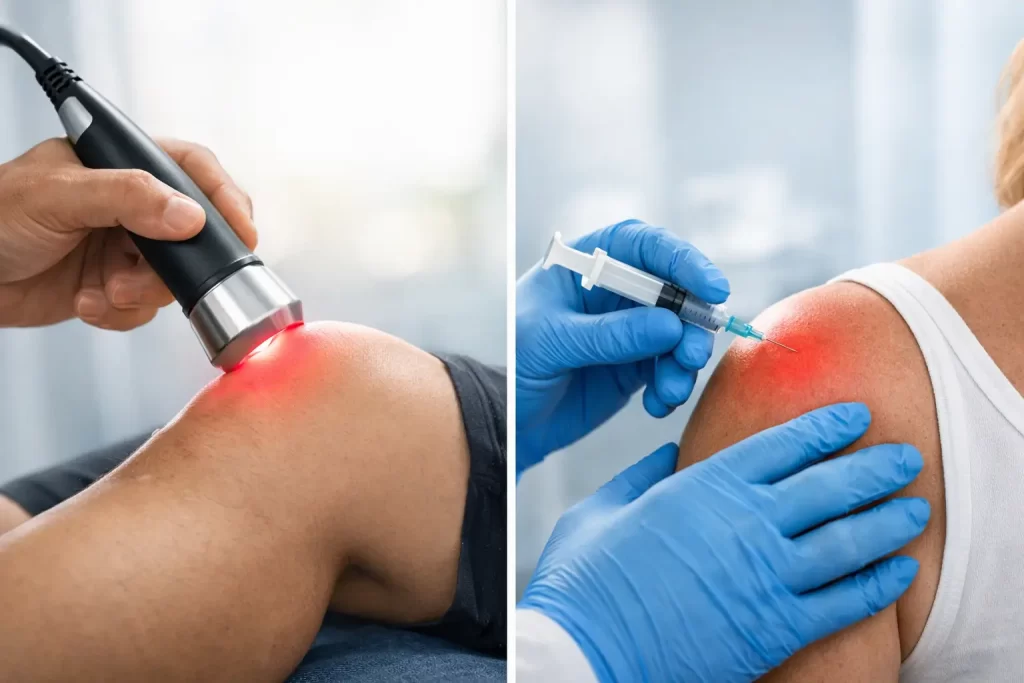
Cortisone is a corticosteroid medication. It is commonly injected into or around a painful joint, tendon sheath, bursa or spinal region to reduce inflammatory activity. In the right setting, it can settle a pain flare and improve movement relatively quickly. That is why it is frequently used for conditions such as bursitis, some forms of arthritis, frozen shoulder, trigger finger and certain spinal pain presentations.
PBMT uses specific wavelengths of light delivered to injured or painful tissue. The treatment is non-invasive and drug-free. Rather than masking symptoms alone, PBMT is used to influence cellular activity, improve circulation, modulate inflammation and support healing processes in soft tissue, joints and nerves. In clinical practice, it is often considered when patients want to avoid repeated medication use, are not suitable for injections, or need a treatment approach that supports sustained recovery as well as pain relief.
This is where the comparison becomes useful. Cortisone is usually chosen for suppression of inflammation. PBMT is often chosen for modulation of inflammation plus tissue repair support. Those are not the same goal, even if both can reduce pain.
How quickly do they work?
Speed matters when pain is acute. Cortisone can offer faster symptom reduction for some patients, particularly when there is a significant inflammatory component. Not every injection works immediately, and some patients experience a temporary post-injection flare, but the short-term effect can be noticeable within days.
PBMT is not usually framed as a one-off quick fix. Some patients notice reduced pain or improved movement after only a few sessions, especially in acute injuries. Chronic conditions often take longer. The response depends on factors such as the diagnosis, how long the problem has been present, the tissue involved and whether there is ongoing biomechanical stress aggravating the area.
For example, a fresh tendon strain may respond differently from long-standing knee osteoarthritis or nerve irritation that has persisted for months. In those cases, a staged treatment plan is usually more realistic than expecting instant change.
The bigger question: relief or repair?
This is often the deciding factor. Cortisone can be very effective for symptom relief, but it does not directly repair damaged tissue. Its role is to dampen inflammation and reduce pain. That can be clinically useful, especially if pain is so severe that a patient cannot sleep, move properly or participate in rehabilitation.
PBMT is used with a different intention. By targeting mitochondrial activity and cellular metabolism, it may help reduce inflammatory mediators while also supporting tissue recovery. That is particularly relevant in tendons, ligaments, muscles and soft tissue structures where healing quality matters. If a patient has recurring pain because the underlying tissue remains irritated or overloaded, temporary symptom suppression may not be enough.
This does not mean PBMT replaces every cortisone injection. It means the treatment objective should guide the choice. If the immediate priority is calming a severe inflammatory flare, cortisone may be considered. If the priority is a non-invasive treatment that supports healing and function over time, PBMT may be the more appropriate path.
Side effects and safety considerations
Safety is one of the main reasons patients compare PBMT with cortisone in the first place.
Cortisone injections are common and can be appropriate when medically indicated, but they are not risk-free. Potential issues include pain flare after injection, skin or fat atrophy at the injection site, infection risk, temporary blood sugar elevation and, in some settings, concern about repeated use affecting tendon or cartilage health. Frequency matters. A carefully selected injection can be useful, but repeated injections into the same area are not a casual decision.
PBMT has a different safety profile. It is non-invasive, does not involve needles and does not introduce medication into the body. When delivered appropriately in a clinical setting, it is generally well tolerated and suitable for a wide range of age groups. That makes it attractive for patients who are sensitive to medications, wary of injection-related risks, or managing conditions where conservative care is preferred first.
The practical point is this: lower risk does not mean lower value. For many musculoskeletal conditions, a treatment does not need to be aggressive to be effective.
Which conditions suit PBMT, and which suit cortisone?
There is no single rule, but patterns do emerge.
PBMT is commonly considered for tendon pain, muscle injuries, ligament sprains, osteoarthritis, repetitive strain injuries, nerve irritation and chronic soft tissue pain. It can be particularly useful where inflammation, tissue damage and delayed healing are all part of the picture. Patients with persistent shoulder pain, tennis elbow, Achilles tendinopathy, knee pain or post-injury soft tissue pain often ask about PBMT because they want symptom relief without adding medication burden.
Cortisone may be considered more strongly when there is a pronounced inflammatory flare that needs rapid control, or when pain is preventing movement and participation in other treatment. Certain joint and bursal conditions fit this profile. It can also be used diagnostically in some settings, helping clarify whether a specific inflamed structure is driving the pain.
That said, some conditions are not ideal for repeated cortisone use, especially where tendon integrity is already compromised. A tendon that is degenerative rather than purely inflamed needs careful assessment. In these cases, reducing pain without considering tissue quality can create a false sense of recovery.
PBMT vs cortisone for pain in chronic conditions
Chronic pain changes the conversation. If symptoms have been present for months, there is often more going on than inflammation alone. Tissue degeneration, altered movement patterns, nerve sensitisation and reduced function may all contribute.
This is where PBMT can be particularly relevant. In chronic musculoskeletal pain, the goal is rarely just to switch pain off for a week or two. Patients usually want better walking tolerance, more confidence using a shoulder, less stiffness getting out of a chair, or the ability to return to exercise without paying for it afterwards. A treatment plan that supports tissue recovery and function may be more useful than one focused only on short-term suppression.
Cortisone still has a place in chronic care, but it tends to be most valuable when there is a clear inflammatory flare within the broader chronic condition. It is less convincing as a long-term strategy if injections need to be repeated while the underlying problem remains unchanged.
Why proper assessment matters more than the treatment label
Many patients ask whether PBMT is better than cortisone as if the answer should be simple. In medical practice, the better question is: what is causing the pain, and what is the safest and most effective way to treat that specific cause?
A swollen arthritic knee, an irritated bursa, a degenerative tendon and a trapped nerve can all feel like “pain”, but they should not be managed the same way. The diagnosis, stage of injury, severity of inflammation, previous response to treatment and medical history all matter. So do patient preferences. Some people want to avoid injections if possible. Others are seeking immediate relief because pain has become intolerable.
A doctor-led assessment helps separate these scenarios. It also helps identify when PBMT can stand alone, when cortisone may be useful, and when either option should be combined with rehabilitation, activity modification or further investigation.
So which one should you choose?
If you want the shortest answer, here it is: cortisone may offer faster short-term relief for selected inflammatory conditions, while PBMT offers a non-invasive, drug-free option aimed at both pain reduction and healing support.
If you want the more honest answer, it depends. It depends on whether the tissue is inflamed, damaged, degenerative or sensitised. It depends on whether you need urgent symptom control or a plan for recovery. It depends on your age, medical history, previous treatments and tolerance for risk.
For many patients, especially those dealing with recurrent or chronic musculoskeletal pain, the appeal of PBMT is not just that it avoids medication. It is that it fits a broader treatment philosophy focused on reducing inflammation, improving function and supporting tissue repair without adding to the cycle of temporary fixes.
At a clinic such as Laser Pain Therapy in Melbourne, that distinction matters because treatment is built around diagnosis, individual response and medically supervised care rather than a one-size-fits-all recommendation.
The most useful next step is not guessing which option sounds stronger. It is getting clear on what your pain is coming from, because the right treatment is the one that matches the problem, not the one with the loudest reputation.
Contact us today to arrange your consultation and take the first step towards recovery.
Located in Melbourne
(03) 8529 2225 Contact Us