When pain has dragged on for months, or keeps returning despite tablets, injections, physio or rest, patients usually ask a fair question: does the science actually support this treatment? A low level laser evidence review matters because Photobiomodulation Therapy, also called Low-Level Laser Therapy, sits in an unusual space – non-invasive and drug-free, yet increasingly studied in mainstream clinical research.
For people living with tendon pain, osteoarthritis, back pain, neck pain or sports injuries, the issue is not whether laser sounds innovative. The issue is whether it can reduce pain, improve function and support tissue healing in a way that is safe, practical and medically credible. That is where the evidence needs careful reading, not marketing slogans.
What a low level laser evidence review actually looks at
A proper low level laser evidence review does not ask one simple yes-or-no question. It examines several separate outcomes: pain reduction, inflammation control, tissue repair, range of motion, return to activity and durability of results. It also looks at treatment parameters, because with PBMT the dose matters. Wavelength, power, energy density, treatment frequency and the condition being treated all influence outcomes.
This is one reason the evidence can seem inconsistent at first glance. Studies do not always use the same device settings or treat the same diagnosis. A trial on acute ankle sprain cannot be read as though it were identical to a trial on chronic knee osteoarthritis. Nor should results from a poorly dosed protocol be used to dismiss the broader field.
That distinction is clinically important. In musculoskeletal medicine, many treatments work well for some conditions and less well for others. Low-level laser is no different.
Where the evidence is strongest
The most convincing evidence has tended to emerge in musculoskeletal pain and soft tissue injury. This includes conditions such as tendinopathy, neck pain, osteoarthritis, plantar fasciitis, lateral elbow pain and some forms of low back pain. Across these areas, systematic reviews and clinical trials have shown that PBMT can reduce pain and improve function, particularly when the treatment is delivered using evidence-based parameters.
Neck pain is one of the better supported examples. Research has reported meaningful pain reduction in both acute and chronic presentations, with some patients continuing to benefit after a course of treatment has ended. That matters because temporary symptom suppression is not the same thing as recovery support.
Tendinopathies are another area of interest. Tendons heal slowly, and chronic cases often involve a mix of local degeneration, overload and altered biomechanics. PBMT appears to help by modulating inflammation, supporting mitochondrial activity and improving cellular repair processes. It is rarely a stand-alone answer in every case, but it can be a useful part of a broader treatment plan.
For osteoarthritis, the evidence is best understood as supportive rather than miraculous. Patients with knee osteoarthritis, for example, may experience reduced pain and improved movement, especially when laser therapy is integrated with exercise and load management. It does not regrow severely worn cartilage. What it may do is reduce inflammatory pain, improve joint function and make movement more tolerable.
Why the mechanism matters
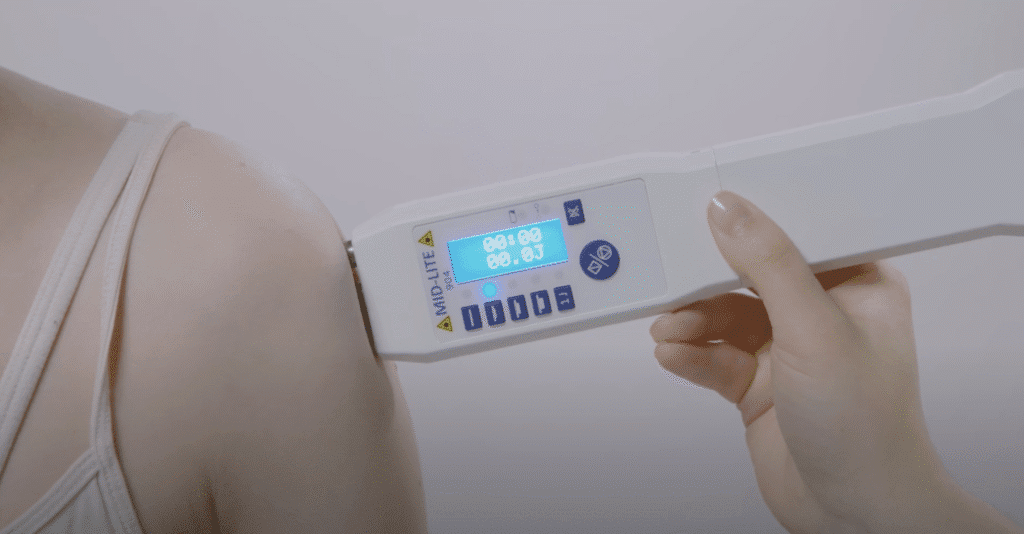
One reason PBMT has gained attention is that its biological mechanism is plausible and increasingly well described. The treatment uses specific wavelengths of light to interact with cellular photoreceptors, particularly within mitochondria. This can influence ATP production, oxidative stress signalling, microcirculation and inflammatory mediators.
In plain terms, the goal is not to heat or burn tissue. It is to stimulate a cellular response that supports healing and reduces pain sensitivity. That is why it is called photobiomodulation rather than surgical laser treatment. The effect is biochemical, not destructive.
For patients, this difference is important. If a treatment is painless and non-invasive, scepticism is understandable. Many people assume stronger sensation means stronger effect. In medicine, that is not always true. Some of the most useful therapies work through subtle physiological change rather than dramatic immediate sensation.
Why results vary between studies
This is where many reviews become either too technical or too simplistic. The practical reality is that PBMT is highly parameter dependent. If the wrong wavelength is used, if the energy dose is too low, if treatment is too infrequent, or if the target tissue is deeper than the protocol allows for, the outcome may be disappointing.
That does not make the therapy ineffective. It means the treatment has to be delivered properly.
This is also why medically supervised care matters. A generic wellness approach may overlook diagnosis, depth of tissue, chronicity, coexisting pathology and the need to combine treatment with rehabilitation. In a clinical setting, laser therapy should sit within a proper assessment framework. The question is not only whether laser can help, but which diagnosis is being treated, what the treatment goal is, and how progress will be measured.
Conditions where caution is needed
A balanced evidence review should also be honest about limits. PBMT is not a cure-all. It is not a replacement for surgery when there is a clear structural need for surgery. It is not a substitute for fracture management, urgent neurological review, infection treatment or cancer care. And while it may help pain associated with many musculoskeletal conditions, not every painful condition responds equally well.
There are also cases where the evidence is still emerging rather than settled. Some neuropathic pain presentations show promise, but outcomes can be variable. Very advanced degenerative disease may improve symptom control without changing the underlying structural stage of the condition. Chronic pain that has become strongly centralised may need a broader pain management plan, because tissue-targeted treatment alone may not be enough.
That is not a weakness of PBMT so much as a reminder that good medicine depends on matching the right treatment to the right patient.
Safety in the evidence base
One of the most reassuring aspects of the literature is the safety profile. When low-level laser is used appropriately, adverse effects are generally minimal. This makes it attractive for patients who want to reduce reliance on anti-inflammatory medication, avoid repeated injections, or pursue a non-surgical option before considering more invasive care.
Safety, however, should not be confused with casual use. Proper screening still matters. Treatment near the eyes requires strict precautions. Patient history matters. Device quality matters. Clinical judgement matters.
For adults managing chronic pain, and for parents considering treatment for children or adolescents with sports and overuse injuries, that combination of safety and supervision is often what makes the therapy worth considering.
What patients should take from the evidence
The fairest reading of the science is this: low-level laser therapy has credible evidence behind it for a range of musculoskeletal and soft tissue conditions, but outcomes depend heavily on diagnosis, protocol quality and clinical context.
That is a stronger position than saying it works for everything. It is also more useful.
If you have persistent tendon pain, joint pain, muscle injury or inflammatory soft tissue pain, PBMT may offer meaningful benefit, especially if previous care has only partly helped or the side effects of medication are a concern. If your condition is complex, long-standing or has not responded to standard treatment, the value of a doctor-led review becomes even greater.
At Laser Pain Therapy, this is why treatment should never begin with the device alone. It should begin with assessment, diagnosis review and a plan built around function, pain behaviour, tissue healing and realistic recovery goals.
The real question behind a low level laser evidence review
Most patients are not looking for a textbook debate. They want to know whether they can walk more comfortably, sleep without being woken by pain, get back to work, return to sport, or play with their children without paying for it the next day.
That is the standard that matters.
The current evidence suggests PBMT deserves a place in modern musculoskeletal care, particularly for patients seeking a non-invasive, drug-free treatment with a sound physiological basis and a favourable safety profile. It is not magic, and it is not universal. But when the diagnosis is clear and the treatment is applied properly, it is far more than a wellness trend.
If you are weighing up options, the next sensible step is not to ask whether laser is good or bad in the abstract. It is to ask whether your specific condition, stage of injury and treatment goals make you a good candidate for evidence-based care.
Contact us today to arrange your consultation and take the first step towards recovery.
Located in Melbourne
(03) 8529 2225 Contact Us