A sore wrist after a long day at the keyboard is easy to dismiss. The problem is when that ache starts arriving earlier, lasts longer, and begins to affect simple tasks such as lifting a kettle, gripping the steering wheel, or sleeping comfortably. That is often when people start looking for treatment for repetitive strain injury and realise it is not one single condition, but a pattern of overuse affecting muscles, tendons, nerves and soft tissue.
What repetitive strain injury actually means
Repetitive strain injury, often shortened to RSI, is a broad term used for pain and dysfunction caused by repeated movement, sustained posture, forceful activity, or poor loading over time. It commonly affects the wrist, hand, forearm, elbow, shoulder and neck, although it can also occur in other areas depending on the task.
Office work is a frequent trigger, but RSI is not limited to desk jobs. We see it in trades, warehouse work, hairdressing, music practice, sport, and even parenting tasks that involve repetitive lifting. The common thread is not the occupation itself. It is the mismatch between tissue capacity and repeated demand.
Some people develop tendon irritation, others nerve sensitivity or muscle overload. That is why a useful treatment plan starts with identifying which structure is involved, how long symptoms have been present, and what is continuing to drive the problem.
Treatment for repetitive strain injury depends on the cause
There is no universal fix for RSI because the label covers several different problems. A person with tendon overload at the elbow needs a different approach from someone with neck-related nerve irritation, or widespread muscle tension from prolonged desk posture.
Early assessment matters because the longer pain continues, the more likely the condition is to become harder to settle. In the early stages, tissue irritation may respond quickly once the aggravating load is reduced. In more persistent cases, pain sensitivity, guarding, weakness and altered movement patterns often become part of the picture.
A medically guided assessment should look at symptom location, aggravating activities, weakness, numbness, sleep disturbance, work setup, and previous treatments. Sometimes imaging is useful, but not always. Clinical examination often provides the clearest direction.
The first goal is to calm the irritated tissue
If an area is repeatedly flaring, treatment usually begins by reducing the load that is keeping it inflamed. That does not always mean complete rest. In fact, total rest can sometimes delay recovery by allowing tissues to weaken further.
A better approach is usually relative rest. This means modifying the provoking task, reducing repetition, improving posture or hand position, changing grip demands, and building in more recovery time. For office workers, that may involve keyboard and mouse changes, monitor height adjustment, and more frequent movement breaks. For manual workers or active people, it may mean short-term changes to volume, force or technique.
Simple pain relief measures can help in the short term, but if they are used without addressing the underlying load problem, symptoms often return.
Why medication is not the whole answer
Anti-inflammatory medication or pain relief can reduce symptoms for some patients, particularly during a painful flare. However, this approach has limits. Medication may dampen pain without improving tissue repair, function, strength or the mechanics that caused the problem in the first place.
For people with persistent or recurring RSI, relying on tablets alone is rarely enough. Many patients are also looking for options that reduce dependence on medication, particularly if they have had side effects, limited benefit, or concern about long-term use.
Evidence-based options used in repetitive strain injury treatment
Effective care is usually multimodal. The exact combination depends on whether the problem is acute, chronic, inflammatory, degenerative, or nerve-related.
Activity modification is often the starting point, but rehabilitation matters just as much. Graded strengthening, mobility work, and correction of aggravating movement patterns help restore capacity so the tissue can tolerate normal use again. This is especially important for tendon-related RSI, where carefully progressed loading tends to be more helpful than prolonged immobilisation.
Splinting or bracing can be appropriate in selected cases, especially where temporary support is needed to reduce strain or protect an irritated structure. The trade-off is that bracing should be used thoughtfully. Too much reliance on external support can contribute to stiffness or deconditioning.
Manual therapy and physiotherapy-based rehabilitation can help some patients, particularly where muscle tension, joint restriction or poor movement control are contributing factors. Ergonomic correction also has a clear role when workstation setup or repetitive task design is part of the cause.
For persistent pain, non-invasive therapies that support tissue healing may be considered alongside exercise and load management.
Treatment for repetitive strain injury with laser therapy
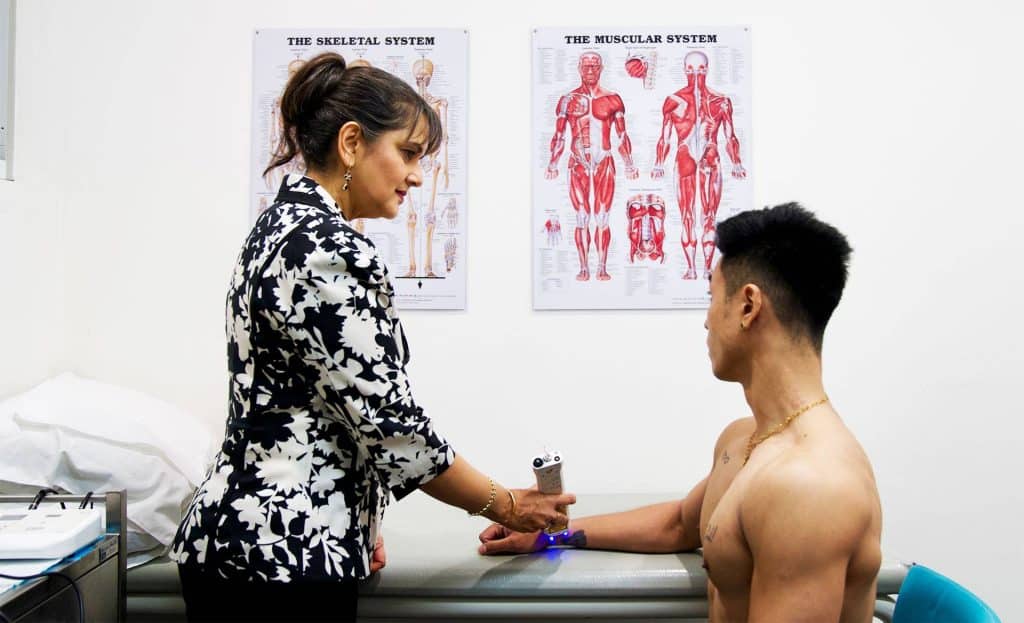
Photobiomodulation Therapy, also known as Low-Level Laser Therapy, is a drug-free, non-invasive treatment used in musculoskeletal medicine to reduce inflammation, support tissue repair, and ease pain. It is not a cosmetic laser and it does not burn or damage tissue. The treatment uses specific wavelengths of light to stimulate cellular processes involved in healing.
In repetitive strain presentations, this can be relevant because RSI often involves inflamed or overloaded tendons, muscle trigger points, irritated soft tissue, or nerve-related sensitivity. The aim is not simply to mask discomfort, but to help create better healing conditions while the mechanical contributors are also being addressed.
Research on PBMT has shown benefit across a range of musculoskeletal conditions, particularly where inflammation reduction, tissue recovery and pain modulation are needed. It is generally well tolerated, painless and suitable for many patients who want a conservative treatment option.
That said, laser therapy is not a stand-alone cure for every case. It works best when integrated into a broader plan that includes diagnosis review, activity modification and progressive rehabilitation. If the original aggravating pattern continues unchanged, even a helpful treatment may only offer partial or temporary relief.
When symptoms suggest something more than simple overuse
Not every sore arm or wrist is straightforward RSI. Some features deserve closer medical review, including persistent numbness, marked weakness, dropping objects, severe night pain, symptoms spreading from the neck, or pain that is not improving despite sensible modification.
These signs may point to nerve compression, cervical referral, inflammatory joint disease, or another diagnosis that needs different management. This is one reason medically supervised care can be valuable. The right treatment depends on getting the diagnosis right.
In longer-standing cases, patients are often told to rest, stretch, or change their desk and then left to manage on their own. Sometimes that works. Sometimes it does not, especially when the condition has already become chronic. A more structured plan can make the difference between temporary symptom control and meaningful recovery.
What to expect from a proper treatment plan
A useful RSI treatment plan should be personalised rather than generic. It should explain what tissue is likely involved, what activities are aggravating it, what can continue safely, and what changes are needed to settle the condition without causing unnecessary loss of function.
It should also set realistic expectations. Mild, early RSI may improve within weeks. Longstanding problems can take longer, especially if there has been repeated reinjury or if work demands cannot be changed easily. Recovery is often gradual rather than linear. Flare-ups can happen even when overall progress is good.
The most effective plans usually focus on four things at once: reducing aggravation, improving tissue healing, restoring strength and function, and preventing recurrence. If one of those elements is missing, recovery may stall.
For patients in Melbourne seeking a non-surgical and medication-sparing option, a clinic such as Laser Pain Therapy may be considered when repetitive strain symptoms have become persistent or have not responded well to conventional care alone.
The biggest mistake people make
The most common mistake is waiting until pain becomes constant before seeking help. Many people push through early warning signs because they can still work, train, or manage the household. By the time they act, the problem is no longer a simple irritation. It has become a cycle of inflammation, compensation and sensitised pain.
The other mistake is chasing quick fixes while keeping the same aggravating habits. Repetitive strain injuries usually improve when treatment is paired with meaningful change, even if those changes are temporary and modest.
If your symptoms are recurring, spreading, or affecting your sleep and function, that is usually a sign the problem needs a more thorough assessment. Good treatment is not just about reducing pain today. It is about helping the tissue recover properly so daily activities feel normal again.
The encouraging part is that many repetitive strain injuries respond well to early, evidence-based care, particularly when treatment is tailored to the person rather than the label.
Contact us today to arrange your consultation and take the first step towards recovery.
Located in Melbourne
(03) 8529 2225 Contact Us