That first sharp pull in a tendon often seems minor – until it starts interfering with stairs, work, sleep or exercise. Laser treatment for tendonitis is increasingly being considered by patients who want more than just temporary pain relief, especially when rest, anti-inflammatories or standard therapy have not brought lasting improvement.
Tendonitis can affect almost any tendon, but the pattern is familiar. Pain develops with movement, stiffness builds after rest, and everyday activities become harder than they should be. For some people it settles quickly. For others, it turns into a frustrating cycle of aggravation, short-term improvement and relapse.
What tendonitis actually involves
A tendon connects muscle to bone. When that tissue is overloaded, strained or repeatedly irritated, it can become painful and inflamed. Common sites include the shoulder, elbow, wrist, hip, knee and Achilles tendon.
In early cases, inflammation may play a larger role. In longer-standing cases, the picture is often more complex. The tendon may show microdamage, disorganised collagen fibres, local swelling and impaired healing rather than simple inflammation alone. That matters because treatment needs to do more than just numb pain. Ideally, it should support tissue repair while reducing irritation.
This is one reason many chronic tendon problems do not respond fully to medication alone. Tablets may reduce symptoms for a time, but they do not directly improve tendon cell function or tissue recovery. If the underlying irritation persists, the pain often returns.
How laser treatment for tendonitis works
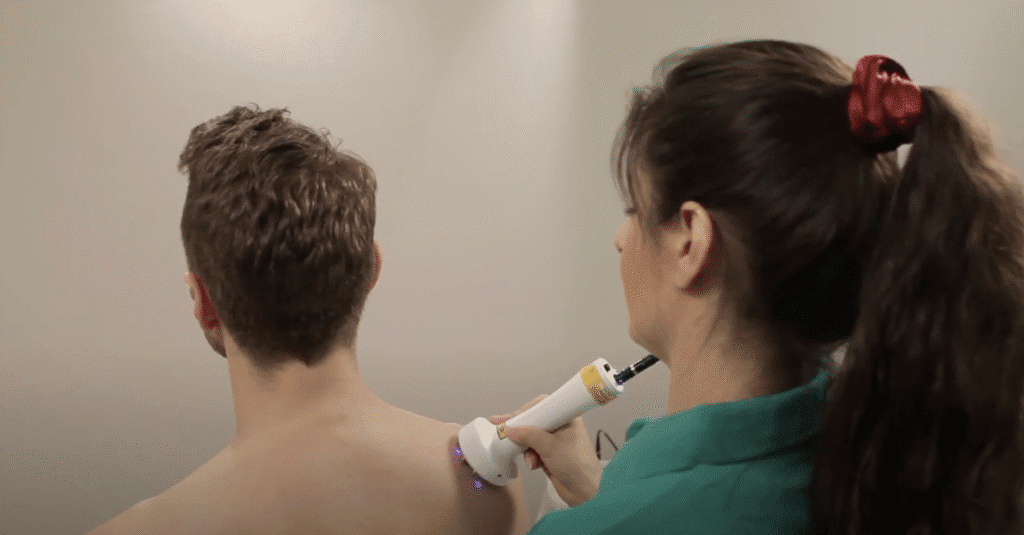
In a medical setting, laser treatment for tendonitis usually refers to Photobiomodulation Therapy, also known as Low-Level Laser Therapy. This is a non-invasive treatment that uses specific wavelengths of light to stimulate cellular activity in injured tissue.
The light does not burn or cut the skin. Instead, it penetrates the tissue and is absorbed by cells, particularly within the mitochondria, which are involved in energy production. When this process is stimulated appropriately, it may help improve circulation, reduce inflammatory activity, support cellular repair and encourage healthier tissue recovery.
For tendon injuries, that can be clinically relevant in several ways. Pain may reduce because inflammatory mediators are modulated and local irritation settles. Healing may improve because fibroblast activity and collagen production can be supported. Function may improve because reduced pain allows more normal movement and better progression through rehabilitation.
This is where properly delivered care matters. The effect of PBMT depends on treatment parameters, diagnosis, tissue depth and stage of injury. A recent Achilles flare-up is not treated in exactly the same way as a long-standing rotator cuff tendinopathy or persistent tennis elbow.
Which tendon problems may respond well
Laser therapy is often considered for both acute and chronic tendon conditions. These may include Achilles tendonitis, patellar tendon pain, tennis elbow, golfer’s elbow, De Quervain’s tendon irritation, rotator cuff tendon pain and gluteal tendon problems around the hip.
Response can vary from person to person. Acute tendon irritation may settle faster because the tissue is still in an earlier healing phase. Chronic cases can also respond well, but they may require a broader treatment plan because the tendon has often adapted poorly over time. There may be stiffness, weakness, altered movement patterns or repeated overload from work, sport or posture.
That is why a medically guided assessment is important. Not every pain labelled as tendonitis is actually coming from the tendon itself. Shoulder pain may involve the bursa or joint. Heel pain may be linked to the plantar fascia. Elbow pain may be tendon-related, nerve-related or both. Good treatment starts with getting the diagnosis right.
What the evidence says
PBMT has been studied across a range of musculoskeletal conditions, including tendon disorders. Research supports its potential to reduce pain and improve recovery when the correct dose and protocol are used. The strongest results tend to come from clinically appropriate application rather than generic treatment.
That distinction is important. Laser therapy is not a magic fix, and not every device on the market delivers the same therapeutic effect. Treatment quality depends on wavelength, power, dosage, treatment duration and how accurately the target tissue is identified.
For tendon conditions, the evidence is best viewed as encouraging rather than simplistic. Some patients notice meaningful pain relief and better function within a relatively short period. Others improve more gradually, especially if the condition has been present for months or years. Where overload, biomechanics or occupational strain are contributing, treatment works best alongside practical changes that reduce ongoing aggravation.
What a patient may notice during treatment
Most patients find PBMT comfortable. The treatment is painless, with little to no sensation apart from mild warmth in some cases. There is no need for needles, sedation or downtime afterwards, which makes it appealing for people who want a non-surgical and drug-free option.
A session is usually brief, but the number of sessions depends on the severity and duration of the condition. A recent tendon flare may improve with a shorter course. A persistent tendon problem that has resisted other therapies may need a more structured treatment plan over several weeks.
Progress is not always linear. Some people feel relief quickly. Others first notice easier movement, less morning stiffness or better tolerance for walking, lifting or gripping before the pain score changes significantly. In chronic cases, gradual gains are common and often more realistic than overnight improvement.
Where laser therapy fits among other treatments
Tendonitis is rarely best managed with a one-size-fits-all approach. Rest can help in the short term, but too much rest may weaken the tendon further. Anti-inflammatory medication may be useful for symptom control, but it has limitations and is not suitable for everyone. Exercise-based rehabilitation remains important, particularly for rebuilding tendon load tolerance.
Laser therapy can fit well into this broader picture because it aims to support healing while reducing pain. That may make it easier for patients to keep moving appropriately, participate in rehabilitation and avoid relying too heavily on medication.
There are, however, trade-offs. If a tendon is repeatedly overloaded by poor technique, heavy physical work or abrupt return to sport, treatment alone may not be enough. If there is a partial tear, calcification or another structural issue, recovery planning may need to be adjusted. If the diagnosis is uncertain, imaging or further medical review may be warranted.
This is where a doctor-led clinic has a clear advantage over generic wellness settings. Tendon pain can look straightforward on the surface but still require careful judgement. The right treatment is not just about access to a laser device. It is about selecting suitable patients, identifying contributing factors and adjusting the plan as recovery unfolds.
When laser treatment for tendonitis may be worth considering
This treatment may be worth discussing if tendon pain is limiting your daily function, if symptoms keep returning, or if medication, rest or standard care have not provided enough improvement. It can also be a sensible option for patients who want to avoid injections or are not ready to consider more invasive treatment.
It may be particularly helpful for office workers with repetitive strain, active adults managing overuse injuries, and older patients whose tendons are slower to recover. Parents also often ask about safe treatment options for young athletes with tendon irritation, and non-invasive therapy can be reassuring when applied under appropriate clinical supervision.
In Melbourne, patients seeking laser therapy should look for medical oversight, clear diagnosis review and a personalised treatment plan rather than a generic package of sessions. That level of care is especially important when pain has become chronic or when previous treatment has not worked.
What to ask before starting
Before beginning treatment, it is reasonable to ask what diagnosis is being treated, whether the tendon problem is acute or chronic, how many sessions may be needed, what outcomes are realistic, and how progress will be reviewed. You should also ask whether the treatment is being combined with advice on activity, load management or rehabilitation.
These questions matter because good care is not only about reducing pain in the moment. It is about giving the tendon the best chance to recover well and stay settled.
For many patients, the appeal of PBMT at Laser Pain Therapy is simple. It offers a clinically grounded, non-invasive option that aims to do more than mask symptoms. When matched to the right diagnosis and delivered as part of a personalised medical plan, it may help calm pain, support tendon repair and make everyday movement feel possible again.
If your tendon pain has been lingering longer than it should, the most useful next step is not guessing – it is having the problem properly assessed so treatment can match what the tissue actually needs.
Contact us today to arrange your consultation and take the first step towards recovery.
Located in Melbourne
(03) 8529 2225 Contact Us