A strained shoulder that still aches months later, a stubborn Achilles tendon, or a knee that never quite settled after a fall often has one thing in common – healing has slowed or stalled. That is where understanding how laser therapy supports tissue repair becomes useful. For many patients, especially those trying to avoid more medication or invasive procedures, photobiomodulation therapy offers a clinically grounded way to support the body’s own healing response.
Laser therapy is not simply about masking pain. In a medical setting, its real value lies in influencing the biological processes involved in recovery. When used appropriately, it can help reduce inflammation, improve local circulation, support cellular energy production and create better conditions for injured tissue to repair.
How laser therapy supports tissue repair at a cellular level
Tissue repair starts well before you notice less pain or better movement. After an injury, cells need energy to control inflammation, clear damaged material and build new tissue. If that process is disrupted by poor circulation, ongoing overload, age-related slowing, or chronic inflammation, healing can become incomplete.
Photobiomodulation therapy uses specific wavelengths of light to interact with cells in the injured area. The light energy is absorbed by structures within the cell, particularly the mitochondria, which are responsible for producing cellular energy in the form of ATP. When ATP production improves, cells have more energy available to carry out repair functions.
This matters because healing is metabolically expensive. Tendon cells, muscle fibres, ligament tissue and nerve tissue all need energy to recover. If those cells are underperforming, recovery may drag on. Laser therapy does not force tissue to heal unnaturally. It supports the conditions needed for normal repair to happen more effectively.
At the same time, laser therapy can influence inflammatory mediators. Inflammation is not the enemy in every case – it is a necessary part of healing. The issue is uncontrolled or prolonged inflammation, which can increase pain, delay tissue remodelling and contribute to persistent dysfunction. By helping regulate this response rather than simply shutting it down, laser therapy can be particularly useful in subacute and chronic injuries.
Why damaged tissue sometimes struggles to heal
Patients are often told an injury should settle in six weeks, yet months later they are still limping, avoiding stairs or waking with stiffness. The reason is that tissue healing is not just about time. It also depends on tissue type, blood supply, movement patterns, age, load, and whether the original diagnosis was accurate.
A muscle strain may recover relatively quickly because muscle tissue has a better blood supply. Tendons and ligaments often take longer. Joint structures affected by osteoarthritis can remain irritated because mechanical stress continues every day. Nerves can be slower again, particularly if there is ongoing compression or sensitisation.
This is one reason medically guided care matters. If the problem is not clearly identified, treatment can become generic. A painful elbow may be labelled as overuse when the primary issue is cervical referral. A sore heel may be treated as plantar fasciitis when there is also nerve involvement. Laser therapy can be very helpful, but it should be applied to the right diagnosis and fitted into a broader treatment plan.
What laser therapy may do during each stage of healing
In the early stage after injury, the main goals are usually to calm excessive inflammation, reduce pain and limit secondary tissue damage. Laser therapy may help by improving microcirculation and moderating inflammatory activity in the affected area. This can make the tissue environment less hostile and more favourable for repair.
In the proliferative phase, when the body starts laying down new tissue, laser therapy may support fibroblast activity, collagen production and cellular metabolism. That does not mean every tendon or ligament suddenly regenerates at the same rate. It means the tissue may have better support for rebuilding.
Later, in the remodelling phase, the challenge becomes restoring tissue quality and function. New tissue needs to adapt to load. This is why laser therapy is often most effective when paired with sensible rehabilitation rather than used in isolation. A tendon, for example, may feel less painful after treatment, but it still needs graded strengthening if it is to tolerate walking, stairs or sport.
How laser therapy supports tissue repair in common conditions
The principles are similar across many musculoskeletal problems, but the clinical application varies. In tendon injuries such as tennis elbow, Achilles tendinopathy or rotator cuff irritation, the aim is often to reduce persistent inflammation and support cellular repair in tissue that has become overloaded or degenerative.
For muscle injuries, laser therapy may assist with pain reduction, swelling control and recovery of damaged fibres. This can be useful in calf strains, hamstring strains, back muscle spasm and post-exertional soft tissue injury.
In ligament sprains, such as ankle injuries, therapy may help the healing response in tissue with limited blood supply while also supporting pain reduction and function. In arthritic joints, the goal is usually not to reverse structural degeneration, but to reduce inflammatory pain, improve movement and support the surrounding soft tissues. That distinction is important. Good care is honest about what treatment can and cannot do.
Nerve-related pain can also respond in some cases. Where there is irritated or compressed nerve tissue, photobiomodulation may help modulate inflammation and support nerve recovery. Results vary depending on the cause, duration and severity of the condition.
What treatment feels like and what patients can expect
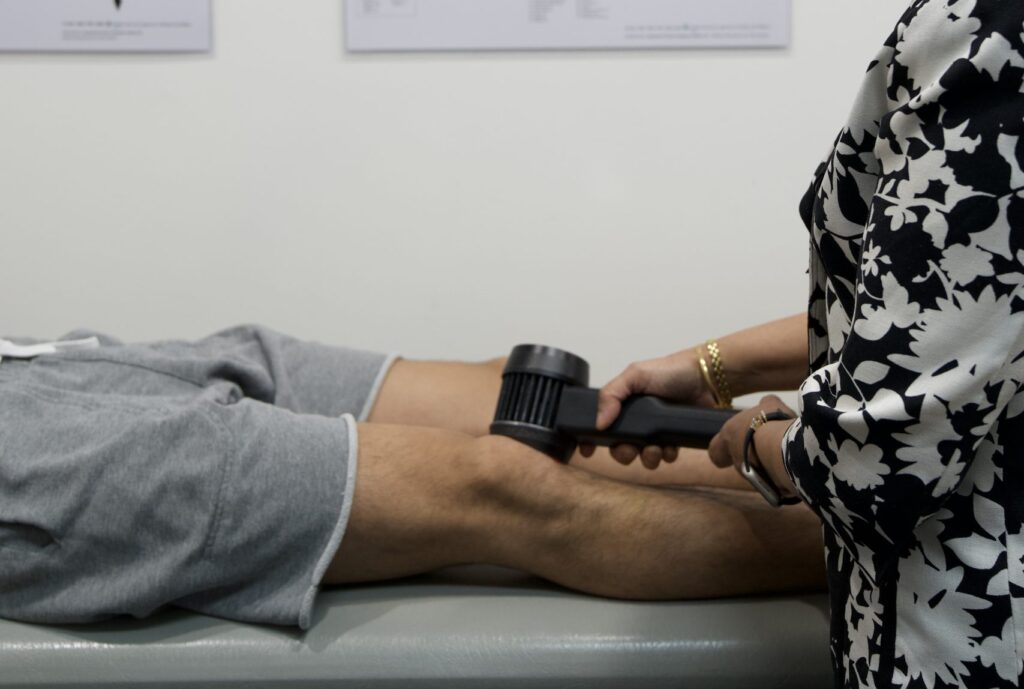
Laser therapy is typically painless and comfortable. Most patients feel little to nothing during the session, although some notice mild warmth. There are no needles, no surgical incisions and no recovery downtime afterwards, which is one reason it appeals to people managing work, family responsibilities or limited mobility.
The number of sessions needed depends on the condition. A recent injury may respond relatively quickly. A chronic tendon problem, longstanding neck pain or arthritic joint issue usually takes longer because the tissue has been under strain for much longer. Frequency also matters. Early treatment courses are often closer together to build momentum.
Response is not always linear. Some patients notice pain relief early, while others first notice improved movement, easier sleep or less morning stiffness before the pain changes significantly. In chronic pain, the aim is often not just symptom relief for a few days, but steadier improvement in function and tissue recovery over time.
Why medical assessment improves outcomes
One of the biggest misunderstandings about laser therapy is that it works as a one-size-fits-all wellness treatment. In reality, outcomes depend on factors such as wavelength, dosage, treatment timing, tissue depth, diagnosis and what else is driving the pain.
That is why doctor-led assessment has real value. Before starting treatment, it is important to understand whether the issue is inflammatory, degenerative, mechanical, neuropathic or a mix of several factors. Some patients also need imaging review, medication discussion, load modification or referral for concurrent rehabilitation.
A personalised treatment plan is particularly important for chronic pain. If tissue has been irritated for months or years, there may be secondary muscle guarding, compensatory movement patterns or central sensitisation contributing to symptoms. Laser therapy can still play a useful role, but expectations and planning need to be realistic.
Who may benefit most from this approach
Patients who often respond well are those with acute soft tissue injury, persistent tendon pain, joint inflammation, post-exercise overload, repetitive strain problems and chronic musculoskeletal pain that has not settled with standard care. It can also suit people who want to reduce reliance on anti-inflammatory medication or avoid more invasive treatment where appropriate.
It is also a practical option across age groups. Active adults may use it to support recovery and return to sport. Older patients may value a drug-free option that helps with pain and mobility. Parents often appreciate that it is non-invasive and comfortable when suitable for children or teenagers with sports injuries.
That said, not every condition will respond equally, and not every painful area needs laser therapy. Good clinical care means identifying when it is likely to help, when another treatment should take priority, and when a combined approach is the better choice.
At Laser Pain Therapy in Melbourne, that medical framing matters. Patients are not simply booking a machine-based session. They are being assessed with the goal of understanding why healing has slowed, what tissue needs support, and how to improve recovery in a way that is evidence-based and practical.
When an injury lingers, people often start to wonder whether this is just how things are now. Often, it is not. With the right diagnosis and the right treatment plan, damaged tissue may still have more capacity to recover than it first appears.
Contact us today to arrange your consultation and take the first step towards recovery.
Located in Melbourne
(03) 8529 2225 Contact Us