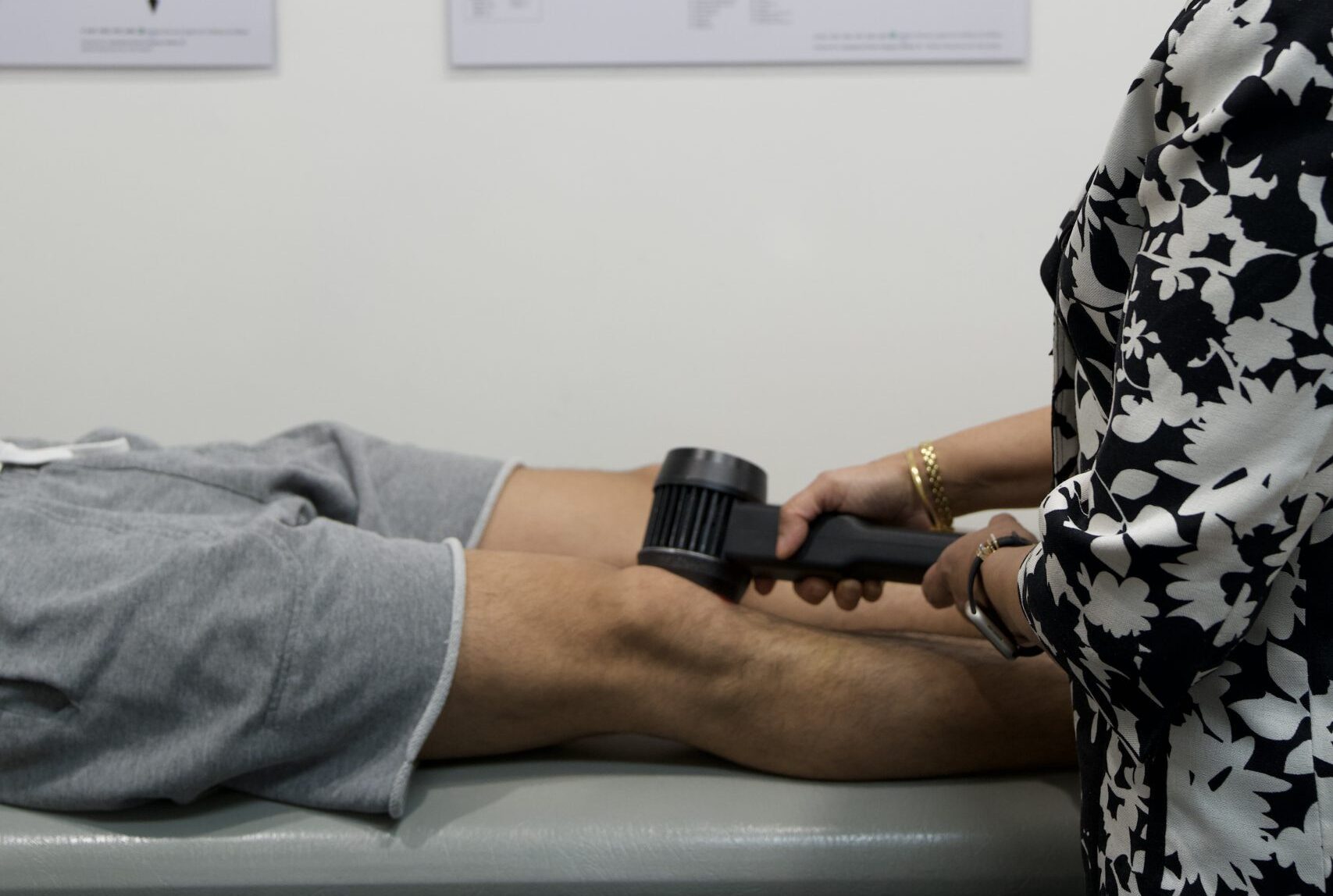
How Laser Therapy Supports Tissue Repair
Learn how laser therapy supports tissue repair by reducing inflammation, improving circulation and helping damaged cells recover safely.
How Laser Therapy Supports Tissue Repair Read More »

Learn how laser therapy supports tissue repair by reducing inflammation, improving circulation and helping damaged cells recover safely.
How Laser Therapy Supports Tissue Repair Read More »

Learn what effective treatment for gluteal tendinopathy involves, from diagnosis and load management to evidence-based laser therapy.
Effective Treatment for Gluteal Tendinopathy Read More »

Learn what affordable private pain clinic care should include, from clear diagnosis and pricing to drug-free treatment that supports recovery.
Affordable Private Musculoskeletal Pain Clinic Care Explained Read More »
At Laser Pain Therapy, we use the terms Low-Level Laser Therapy (LLLT) and Photobiomodulation Therapy (PBMT) interchangeably, as they both refer to the same therapeutic approach. “LLLT” specifically focuses on the use of laser light, while “PBMT” is the broader scientific term describing how light interacts with cells and tissues to influence biological processes involved in tissue recovery.
Both terms refer to light-based therapy that acts on cellular processes involved in local inflammatory modulation, tissue recovery, and healing.
The initial consultation with Dr Shikha Parmar requires up to 60 minutes where your condition is fully assessed along with your medical history. Dr Parmar will take a thorough history of your problem from its onset, through its progression to now. She will review any imaging reports pertaining to your problem, and may recommend further investigations. Dr Parmar will give you a detailed explanation of your problem, and will discuss our holistic approach and management plan including the utilisation of Low Level Laser Therapy (LLLT). If your condition is amenable to LLLT the treatment is commenced at the initial consultation. A medical consultation with Dr Shikha Parmar, GP, is billed and is rebatable through Medicare for patients who hold a Medicare card.
The fee for an initial consultation including Low Level Laser Therapy treatment is $265.00. This includes a Medicare rebate for the GP consultation of $87.10, the out of pocket cost being $177.90.
Pension and Health Care Card holders receive a further reduced fee for the initial consultation of $215.00 only with the out of pocket fee (gap fee) being $127.90.
For each subsequent follow-up consultation involving review of progress, tailored advice and management, and Low Level Laser Therapy treatment, a fee of $135.00 applies. This includes a Medicare rebate for the GP consultation of $45.05, the out of pocket cost (gap fee) being $89.95.
Longer review visits are charged at $215.00 which includes a Medicare rebate $87.10, the out-of-pocket cost being $127.90.
A $15.00 surcharge applies to appointments after 6pm.
Fees may be subject to change and will be confirmed with you at the time of booking. We utilise specialised equipment from Europe and the USA, operated with the assistance of highly trained clinic assistants. No further rebate can be claimed from private health insurance. We are unable to offer bulk billing.
Yes. LLLT/PBMT has been used clinically in Europe for nearly 30 years and has been the subject of substantial published research. The literature includes double-blind studies, laboratory studies, randomised controlled trials, clinical studies and systematic reviews. The strength of evidence varies according to the condition being treated, treatment parameters and clinical context.
Published literature includes papers in journals such as:
Over 2,500 clinical studies and published research reports have investigated the use of LLLT/PBMT across a variety of health issues. In the LLLT dental literature alone, involving 370 studies, more than 90% of these studies have reported clinical value for laser therapy.
LLLT has been used in veterinary practices for decades. In recent years, professional sports teams have also begun utilising LLLT/PBMT.
In the last 20 years, 8 systematic reviews have reported findings in favour of LLLT/PBMT in selected clinical contexts, including:
Laser Therapy does not heat or cut tissue, unlike high intensity lasers. The question is often asked: “If it’s a laser, aren’t lasers used in surgical operations to cauterise tissue?” The answer is yes. High intensity surgical lasers can cauterise or cut tissue. The lasers used at Laser Pain Therapy are Class 3B low level lasers, a well-researched class in LLLT, designed for low-intensity therapeutic application. Our lasers use light energy to influence cellular processes rather than heat or cut tissue.
Regulatory bodies assess LLLT/PBMT devices according to intended use and device class. Device selection, dosing and clinical supervision are important for appropriate application.
For the past 30 years, Low Level Laser Therapy (LLLT) technology has been formally accepted in many parts of the world such as Canada, USA, Brazil, Europe, Scandinavia, Russia and Japan. Published research and clinical experience over this period support a favourable tolerability profile. LLLT/PBMT is non-invasive and generally well tolerated.
Industry has been using laser diodes for years in applications such as bar code readers, CD players, DVD players, laser printers and pointers. Some bio-stimulation laser devices have been listed as non-significant risk (NSR) devices in specific regulatory contexts.
Hundreds of research studies have investigated Laser Therapy in pain and tissue recovery settings. Laser Therapy is non-invasive and non-thermal. Over 400 LLLT clinical trials (RCTs) and over 2500 laboratory studies have been published. Comparisons with pharmaceutical anti-inflammatory medication depend on the condition being treated, study design and treatment parameters.
LLLT has also been investigated for tissue recovery processes, muscle fatigue, muscle damage and delayed onset muscle soreness, or DOMS.
Most patients tolerate LLLT/PBMT well. Patients may occasionally experience mild discomfort or aching after treatment. This is usually temporary and should settle within 24 to 48 hours.
LLLT/PBMT uses red and near-infrared light and does not use ionising radiation. No mutational effects have been observed from light with wavelengths in the red or infrared range and doses used within LLLT/PBMT in published studies.
Where a patient has known or suspected cancer, this requires medical assessment and appropriate management. LLLT/PBMT at Laser Pain Therapy is not used as a treatment for cancer.
The effects of LLLT/PBMT on cancer cells have been studied in vitro and in animal models, but these findings should not be translated into broad clinical claims about treating cancer or tumour behaviour in people. Treatment decisions are made according to the patient’s clinical context and medical history.
Similarly, laboratory findings involving bacteria or viruses can differ from clinical infection management. This section should not be read as a claim that LLLT/PBMT treats bacterial or viral infection. If infection is suspected, appropriate medical assessment and treatment are required.
Laser Therapy should be avoided in the following instances:
At Laser Pain Therapy, we use state-of-the-art, TGA-approved laser devices, applied by highly trained assistants. Our laser devices deliver the appropriate red and infrared laser energy to trigger the desired tissue response. With the application of up to 37 diodes (laser lights) across multiple devices, we ensure time-efficient treatment without compromising dosage or energy delivery. Unlike LED devices, our laser technology provides deeper penetration and more effective tissue healing.
Dr Shikha Parmar, an experienced GP with over 30 years in General Practice and 14 years of expertise in photobiomodulation therapy, leads our clinic, making her one of the most experienced doctors in this field. Treatment at Laser Pain Therapy is medically supervised, ensuring each patient receives a thorough assessment that takes into account not only their presenting condition but also relevant health factors, such as co-morbidities, medications, lifestyle, work, personal activity demands, and nutritional deficiencies. This holistic approach allows us to tailor care with LLLT at the core, supported by personalised advice.
Additionally, our treatment plans are finite, with clear goal-setting and regular progress reviews, ensuring that each patient is on track towards long-term recovery and optimal outcomes.
At Laser Pain Therapy, we use advanced equipment with laser diodes, not LED lights. Unlike LEDs, laser diodes provide more focused light with deeper penetration, making them significantly more effective for treating musculoskeletal conditions.
Our state-of-the-art equipment features 37 laser diodes, allowing us to efficiently cover a larger surface area. This optimises treatment time, ensuring deeper penetration for superior results. Unlike devices that use just 2-4 diodes, our technology delivers more effective treatment in less time, promoting faster healing, reduced inflammation, and long-lasting pain relief.
The effects of LLLT are accumulative. The good news is that for most patients undergoing a treatment program, the results from the treatments are sustained. While some patients get immediate results, improvements are often not noticed until after 3 to 5 treatments. Most patients usually require 6-12 treatments to achieve resolution of the problem or a lasting effect.
More severe conditions will require more treatments than less severe injuries. Since each person’s condition varies in severity the doctor will determine after reviewing your condition how laser treatments may benefit you and how many you might require
Your situation will be assessed after 6 treatments and if there is no improvement after 6 to 8 treatments (very uncommon), LLLT will not be continued and alternatives will be looked at for your future management.
You will need to follow precautions in order to avoid re-injury or the pain may return. Low Level Laser Therapy not only helps injured tissues heal faster, it also makes them stronger and less vulnerable to re-injury.
Contact us to book a consultation at our clinic or to learn more about how this form of therapy could help you.
No. Low level lasers do not generate perceivable heat. Therefore, when the laser contacts the skin the patient experiences no burning as a result of the laser. Most people feel nothing at all while a few may feel a slight tingling or warmth during the treatment.
No. As Dr Shikha Parmar is a General Practitioner a doctor’s referral is not required.
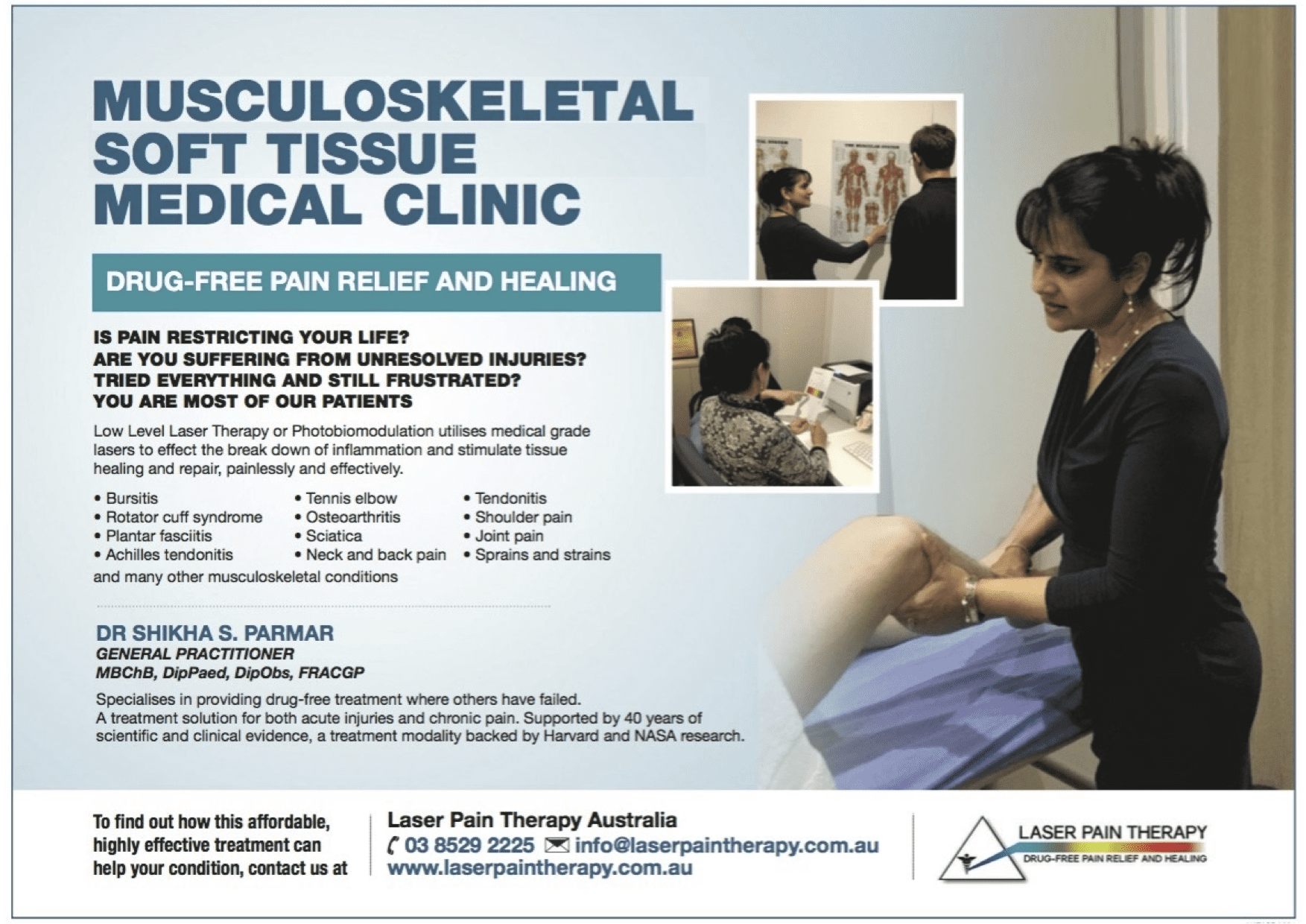
Images and Illustrations Disclaimer
Please note that the images, diagrams, and illustrations used on this website are for demonstration and illustrative purposes only. They are intended to provide a general overview of Photobiomodulation Therapy (PBMT) and Low-Level Laser Therapy (LLLT). The specific methods and equipment we use at Laser Pain Therapy may differ from those depicted. For instance, while some images may show a small laser being applied to the skin, we utilise advanced cluster lasers equipped with multiple diodes, offering superior coverage and effectiveness for treating musculoskeletal conditions. Our treatment protocols are tailored to each patient’s unique needs, using the latest technology for optimal results.
Expect reply within 3 business days. Please check your spam folder.

South Yarra, Victoria
Suite 8, 200 Toorak Road
(Ground floor from William St)
South Yarra, Vic 3141
Ph: 03 8529 2225
Email us:
info@laserpaintherapy.com.au
TRANSPORT ACCESS:
Train: South Yarra Station, 100m, 1 minute walk
Tram: Route 58, stop no. 127
Easy free street parking:
If driving you will find many free 1P and 2P spots on and around Toorak Rd and William St near the clinic.
We are dedicated to providing advanced, evidence-informed and affordable medical care for selected musculoskeletal pain and injury presentations. Our approach combines GP-led assessment, individual treatment planning, non-invasive PBMT/LLLT, and practical guidance to support pain relief, recovery, function, and quality of life.
The contents of this website have not been evaluated by the Australian Government Department of Health. The information of this site is not intended to diagnose, treat, cure or prevent any disease. Individual articles are based upon the opinions of the author, who retains copyright as listed…..Continue Reading